
When Friction Became a Problem
Exploring The Time Before Terry v. Ohio

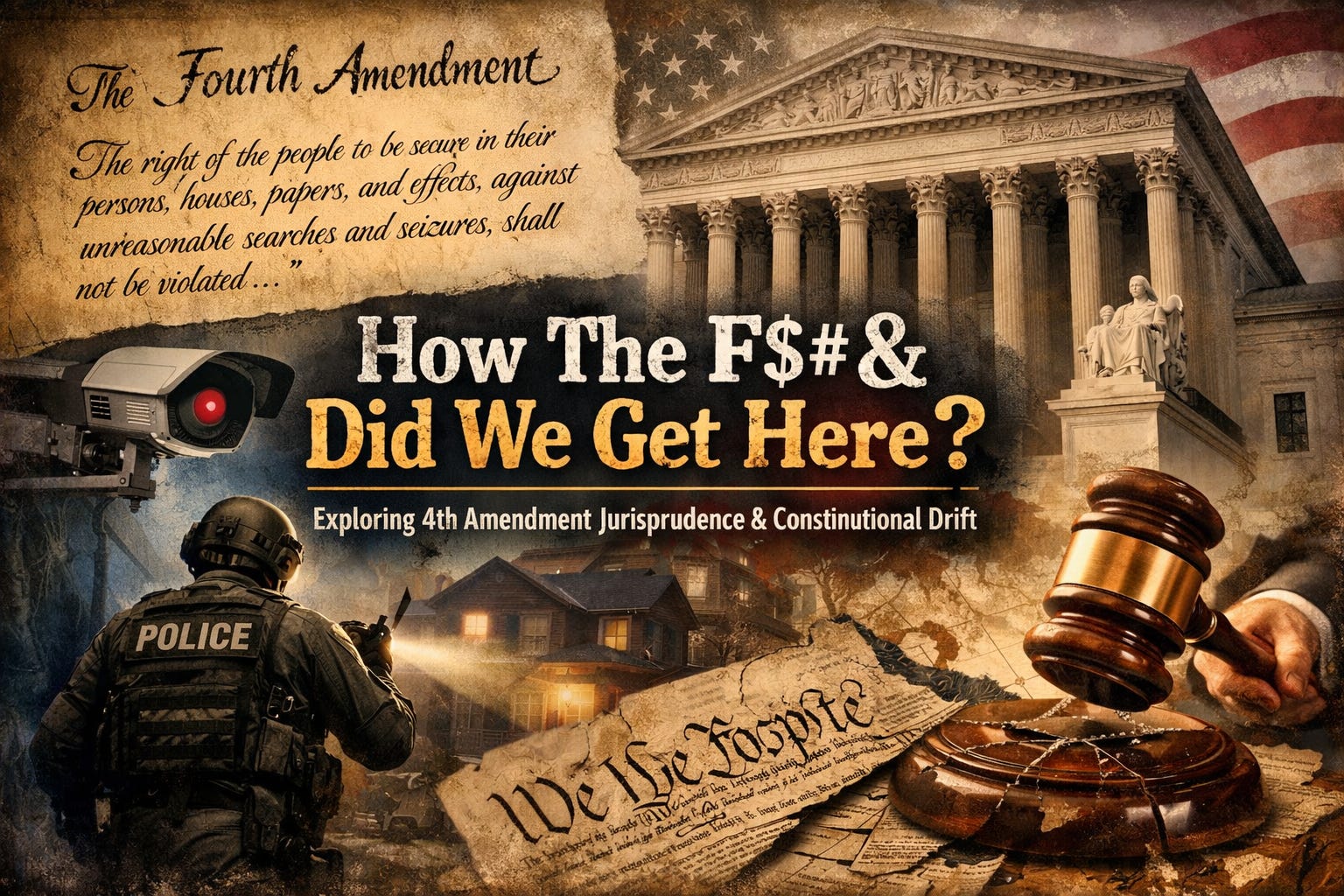
What happens when the system begins to smooth the very friction it was built to preserve?
It’s important to consider that incrementalism is one of the most powerful processes in life. Nothing happens all at once, and what finalizes itself as an end result rarely begins with villains, malevolence, or nefarious intent.
Sometimes, erosion of safeguards happens as a battle against inconvenience, and an attempt to make jobs easier.
The Constitution was designed to slow power down. That was the point. Legislation required two chambers and a President. Federal power was limited and enumerated. States retained authority. Courts were not roving commissions to fix social problems. They decided cases. Slowly.
But friction must have felt different depending on where one was standing.
To the founders, friction was protection.
To later generations, friction often felt like obstruction.
As the young republic grew, so did its problems. Westward expansion was soon joined by financial panics, internal rebellions, slavery, industrialization, railroads, labor unrest, and War.
With each crisis came pressure to act faster, and with each pressure point came a familiar question:
Is the structure helping, or hindering?
The First Stress Test: National Survival
The Civil War was the first true stress test of the constitutional design.
When the Union was at risk of collapse, President Abraham Lincoln suspended habeas corpus — a Latin term referring to the right to force the government to bring a person before a court and explain why they are being held.
Pursuant to Lincoln’s order, people were detained without the normal judicial process. The justification was survival. Rebellion required speed. Courts were slow.
Reality Check:
Does any of the previous paragraph sound familiar, if one considers the dynamic of American life from 2020-present?
Presidents, at worst dispensing with, and at best, testing the outer boundaries of due process in the name of what they believe is necessary for survival?
Depending on their perspective, it might bring a person comfort, knowing that what they look around and see in America, day in and day out, is not something the country has NEVER experienced before.
On the other hand, it may also force a harder acknowledgment: Regardless all of the best advancements in medicine, technology, and human evolution, no society is absolutely immune from the threat of unnecessary conflict. Not in the 1860s. Not now.
Advancements, after all, do not rewrite human nature. They simply change the tools available to it.
Either way, the point is not panic. It is perspective. Understanding the past is one of the few ways to recognize patterns before they fully mature, and if possible, to avoid repeating the worst of them.
After the war, the Supreme Court pushed back in a case called Ex parte Milligan, holding that civilians could not be tried by military tribunals where civil courts were open.
Even in crisis, the Court said, structure matters.
But notice what had already happened.
The question was no longer whether government should have limited powers.
The question was how far those powers could stretch in emergency.
That is a different conversation.
Once the idea takes hold that necessity can bend structure, the conversation never fully goes away, and most significantly, power that has been given room to stretch always wants the comfort of that extension.
Industrial America and Administrative Muscle
By the late 1800s, America was no longer a small republic. It was industrial. Corporate. Urban.
Railroads crossed state lines. Monopolies controlled markets. Labor disputes sparked violent protests.
Congress faced a problem the founders never saw at scale: the daunting nature of trying to regulate a national economy.
In 1887, Congress created the Interstate Commerce Commission, the first major federal regulatory agency. It was a new kind of entity. Not purely legislative. Not purely executive. Not purely judicial. It made rules, enforced them, and adjudicated disputes.
It was efficient.
It was also a softening of separation, and some would argue it was the birth of the administrative state.
During the Progressive Era, presidents like Theodore Roosevelt embraced a more muscular view of executive power. The president, in this view, was not merely executing laws but stewarding the nation. The concept of stewardship introduced an additional layer of discretion and subjectivity in carrying out the duties of the executive. Another long stretch for expanding power, followed by a resistance to retract.
Then came the Great Depression.
The New Deal under Franklin D. Roosevelt dramatically expanded the administrative state. Agencies multiplied. Rulemaking authority expanded. Federal reach deepened into everyday economic life.
At first, the Supreme Court resisted the New Deal. Several major programs were struck down as exceeding Congress’s authority or improperly delegating power.
President Franklin D. Roosevelt did not take that quietly.
In 1937, after winning reelection in a landslide, Roosevelt proposed what became known as the “court-packing plan.” Officially, it was framed as a judicial reform measure. The argument was that older justices were overworked, and the Court needed help managing its docket.
History would regard it as something more strategic: a planned addition extending the foundation of an expanding house of power, with no plans to return to its original shape.
The proposal would have allowed the president to appoint an additional justice for every sitting justice over the age of seventy who did not retire, up to six new justices.
If passed, Roosevelt could have expanded the Court from nine members to as many as fifteen.
The political reality was obvious. The Court had been striking down New Deal legislation. Expanding the Court would allow Roosevelt to appoint justices more sympathetic to his policies.
The plan was legal. The Constitution does not fix the number of Supreme Court justices. Congress sets it. The number had changed before in American history.
But the reaction was swift and bipartisan. Many saw the proposal as an attempt to pressure the judiciary into compliance. Even members of Roosevelt’s own party resisted it.
The plan ultimately failed in Congress.
But something significant happened during the fight.
In what became known as “the switch in time that saved nine,” the Supreme Court began upholding New Deal legislation it had previously been skeptical of. The Court’s resistance softened. The administrative state expanded. Broad delegations of authority became more common.
The Court was not packed. The number remained nine. But the pressure campaign had worked in another way. An institution confronted with the possibility of structural alteration recalibrated.
The high court’s unexpected acquiescence naturally invited a fair question:
Would this be one of the first recorded examples of an institution of power compromising a previous position in the interest of self-preservation?
The following example illustrates the point:
In 1936, in a case called Morehead v. New York ex rel. Tipaldo, the Court held that the law violated “liberty of contract” under the Due Process Clause. This was consistent with earlier decisions like Adkins v. Children’s Hospital (1923). The Court struck down a state minimum wage law as unconstitutional, reaffirming its commitment to a doctrine that treated economic regulation with deep skepticism.
Less than a year later, in West Coast Hotel Co. v. Parrish, the same Court was faced with similar legislation, and upheld it. The constitutional text had not changed. The Due Process Clause had not been amended. The theory of liberty of contract had not been formally repealed by the people.
But the political environment had changed. The Court had been publicly criticized. The president had proposed expanding its membership. The legitimacy of the institution itself had entered the conversation.
It is possible that the justices experienced a genuine doctrinal evolution in that narrow window. It is possible that constitutional understanding matured independently of political pressure.
It is also reasonable to ask about probabilities.
When an institution is confronted with structural alteration, and its position shifts shortly thereafter on materially similar issues, what is the likelihood that the surrounding pressure had no influence at all?
Judges are human beings. Institutions are not immune from incentive structures. Even unconscious awareness of institutional vulnerability can recalibrate how risk is assessed.
Whether the shift was caused by political pressure, evolving judicial philosophy, or some combination of both remains debated.
What is not debated is this: the episode marked a moment when structural friction came under direct political pressure — and when the balance between the branches subtly recalibrated.
Regardless of the cause, after the court-packing crisis and shifting political winds, the Court’s rigidity softened. It began upholding broad delegations of authority to agencies.
Efficiency had won an important round.
The friction was still there, but it was thinner.
War Again, and the Elastic Constitution
World War II brought another test.
In Korematsu v. United States, the Supreme Court upheld the internment of Japanese Americans. The government argued military necessity. The Court deferred.
Today, it is widely regarded as a grave failure.
But in the moment, the pattern was familiar.
Crisis.
Urgency.
Deference.
The Constitution did not disappear. It stretched.
And every time it stretched under pressure, it became a little easier to imagine stretching it again.
The Cultural Shift
None of this was framed as abandoning the Constitution.
It was framed as making government work.
As the 20th century progressed, Americans grew accustomed to federal agencies solving problems. Courts increasingly addressed social questions. Congress delegated broad authority. Presidents acted through executive orders.
The language changed.
The debate was less about limits and more about outcomes.
Does it solve the problem?
Is it effective?
Is it fair?
Those were not illegitimate questions.
But they were different from the founders’ primary question:
Who has the power, and how tightly is it confined?
Over time, friction began to look inefficient.
Delay looked irresponsible.
Structural restraint looked outdated.
And when a society begins to see its guardrails as inconveniences rather than protections, it does not remove them in a single dramatic act.
It sands them down.
Slowly.
Quietly.
Case by case.
Agency by agency.
Emergency by emergency.
Small casualties to the patient stalk of incrementalism.
We are not yet at Terry.
But we are closer than we were.
Because once a nation grows comfortable with smoothing friction in the name of necessity, safety, and efficiency, it is only a matter of time before those same instincts reach beyond economics and war… and into the daily encounter between citizen and state.
And that is where our story is headed next.
I like what you are getting at in your analysis. One can calculate the average rate of change of a society or geological process by dividing the change of state by the elapsed time. However that is not an accurate assessment of what really goes on. Geologic, and I believe societal, changes mostly change slowly from year to year, and rare events cause monumental changes only infrequently. 100 year floods do 95% of the erosion in the Grand Canyon in brief spurts. Volcanoes devastate huge areas in short periods, yet average ash fall rates are minuscule. Huge societal changes are infrequent,but can be devastating. War, famine, disease, and corruption operate in similar fashion to cause social changes. We need to recognize this in order to properly assess the current state of society, determine how it might change and address the negative changes with sufficient gusto to ameliorate the damage they will cause. Destroyng a sub-optimal system with no idea of how to replace it with something better, and with no analysis is foolhardy.
What are the chances that all of the events leading up to the current state of the onion were random, organic and not guided by intelligence?
I have a conspiracy theory!!! 😁